Extracted and cleaned review data for British Airways from Airline Quality
Used BeautifulSoup from bs4 to scrape review data, to be saved into a .csv file.
Extracted verification status of trip from review text
SentimentIntensityAnalyzer() to acquire the sentiments of the text for data analysis.
Visualised the distributions of compound sentiment, grouped by verified_trip.
In general, there are greater proportions of people with more extreme values of compound sentiment than of those with compound sentiment of 0, with slightly greater proportion of negative sentiment values compared to positive ones.
Both charts demonstrate that between people with verified trips and those without, those with verified trips have slightly more extreme sentiments, but otherwise the distributions of compound sentiment are relatively similar.
Conducted exploratory data analysis on the given flight schedule to determine how to categorise and measure demand for lounge eligibility.
Flight types and departure times often influence customer profiles and lounge usage behaviours, so TIME_OF_DAY was used as a category.
Different types of aircrafts have different proportions of each type of seating, and thus may impact the accessibility for lounge usages, such as Tier 1 permitting all First Class customers, so AIRCRAFT_TYPE was used as a category.
Proportions of eligible customers for each tier per flight calculated using TIER1_ELIGIBLE_PAX, TIER2_ELIGIBLE_PAX, TIER3_ELIGIBLE_PAX divided by the total number of passengers in their corresponding flights.
Conducted exploratory data analysis on the customer booking data
.info() to determine the data types and number of null values for each column.
.describe() for distribution metrics for numerical columns.
Trained multiple machine learning models and compared their effectiveness.
All ML models included a preprocessing pipeline for the data before training and usage; all numeric columns have StandardScaler() applied to them, all ordinal columns have OrdinalEncoder() applied to them, and the remaining non-numeric columns have their data type converted to categories with FunctionTransformer(), followed by one-hot encoding.
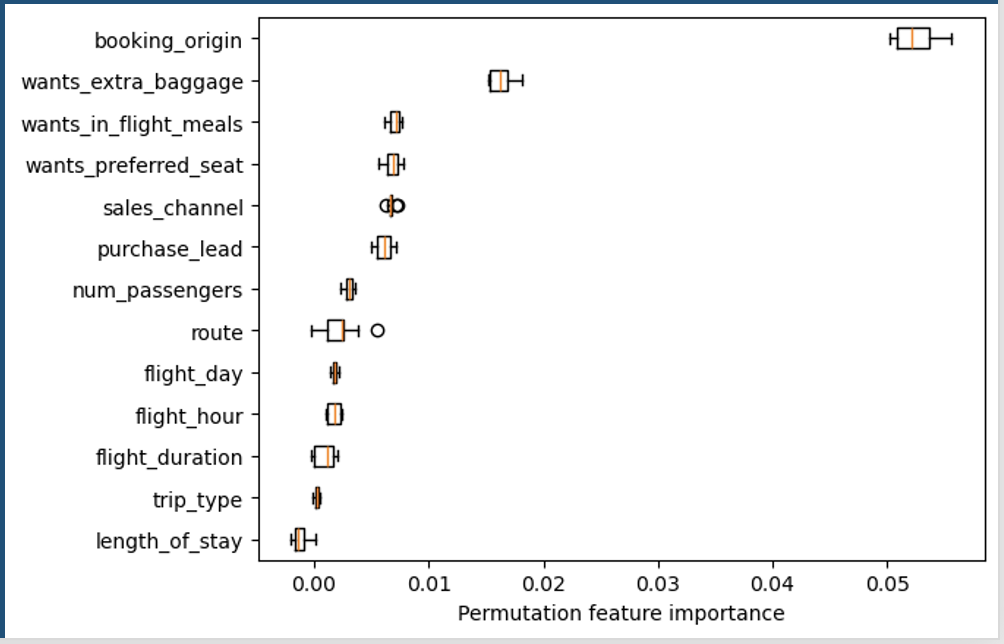
Tree-based ensemble model can only provide permutation importance in place of feature importances.
booking_origin has greatest feature importance, followed by the various customer wants, with emphasis on extra baggage.
Optimised LogisticRegression():
All the given extreme coefficients are encoded route variables.
Various routes appear to provide consistently most extreme coefficients for predicting person’s customer buying behaviour; questionable given that majority of variables created from transformations are from route.